RV-Sparse Coding Challenge Solution | LFX 2026
RV-Sparse Coding Challenge
Problem
Convert a dense row-major matrix into CSR format and compute y = A.x using the extracted sparse representation.
Implement a function that:
- Scans a row-major matrix A and identifies its non-zero elements.
- Extracts them into Compressed Sparse Row (CSR) format using caller-provided buffers.
- Computes the matrix-vector product y = A * x using the extracted CSR data.
- Write the result directly into a caller-provided output buffer.
Critical constraint:
The function must perform zero dynamic memory allocation. All memory is pre-allocated by the caller.
Representation
To implement a solution this problem, first I needed to understand what:
- Sparse Matrix is
- CSR format looks like
- and why is it efficient than normal Matrix Vector multiplication
From my understanding, some descriptions are in order:
Sparse Matrix
A matrix where most entries are zero or technically, it is a matrix whose ratio of zero elements to non-zero elements is > 1, which effectively means that most of its entries are zero.
CSR Format
There are numerous ways to store a sparse matrix in memory, such as, Compress Coordinate (COO), Compressed Sparse Column (CSC), and Compressed Sparse Row (CSR) format. We employ CSR format in this problem.
The CSR format uses 3 arrays to store complete information of a sparse matrix.
valuesarray contains all non-zero elements of the matrix.column_indicesarray stores the column index ofvaluesentries in the original dense matrix.row_ptrsarray defines where each row starts and ends inside thevaluesarray, corresponding to original matrix.
Efficiency
The sparse matrix representation achieves efficiency by completely eliminating the need to process zero entries. Since zeroed entries aren't stored, they aren't multiplied with the target vector, saving cycles in proportion to count of zero entries.
The following example helped me understand the process a lot better.
Example:
Consider the following loosely sparse matrix:
A = [
[10, 0, 20],
[ 0, 30, 0],
[40, 0, 50]
]
can be stored in CSR format as:
values = [10, 20, 30, 40, 50]
col_idx = [0, 2, 1, 0, 2]
row_ptrs = [0, 2, 3, 5]
The row_ptrs array works more as a slicing guide for values array, for example:
first_row = values[0:2]
second_row = values[2:3]
third_row = values[3:5]
Approach
This problem consists of two parts:
- Storing the user provided matrix (A) into a sparse matrix representation
- Multiplying the sparse matrix with an input vector array.
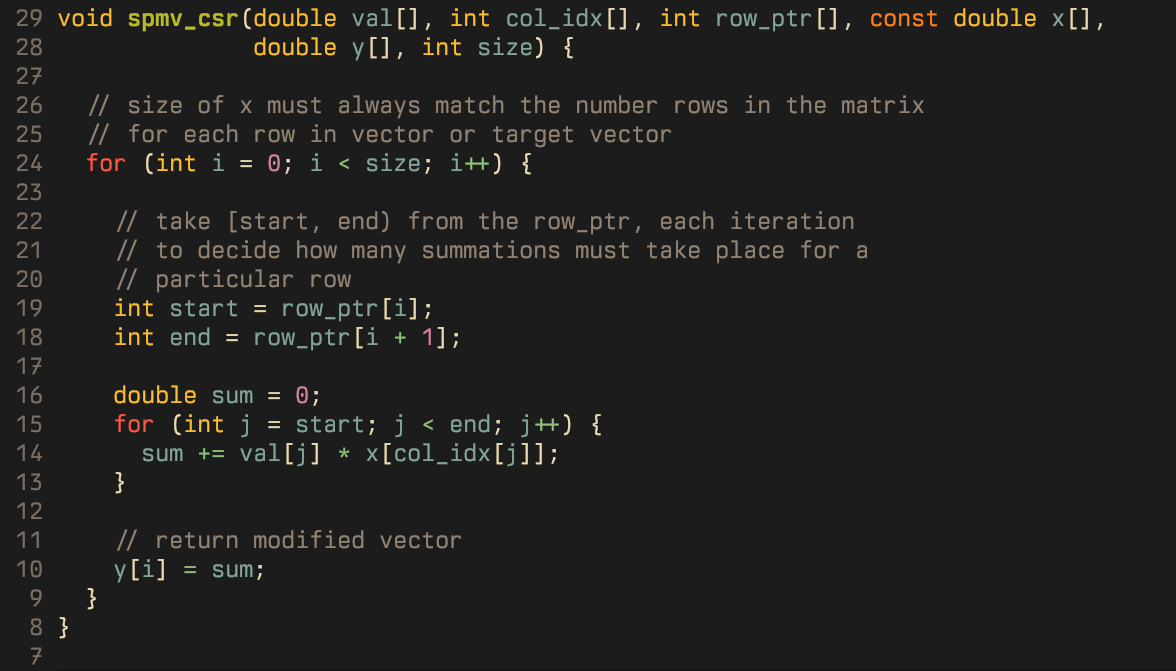
I personally solved these in reverse order because I first needed the intuition for sparse vector multiplication itself, so I implemented the spmv_csr routine first.
Sparse Matrix Multiplication
It works as follows:
- Take in sparse parameters such as val, col_idx, row_ptr , input and output vectors: x,y and size of input/output vector.
- Each output element y[i] is the dot product of row i with vector x
- For each entry in y, extract [start,end) indices from row_ptr.
- Compute sum for each entry of y by using col_idx[j] to select corresponding element from x to be multiplied with current element from values array.
- Update output vector with newly computed sum.
I tested this implementation with some examples and it worked! Next I moved on to solving the first part.
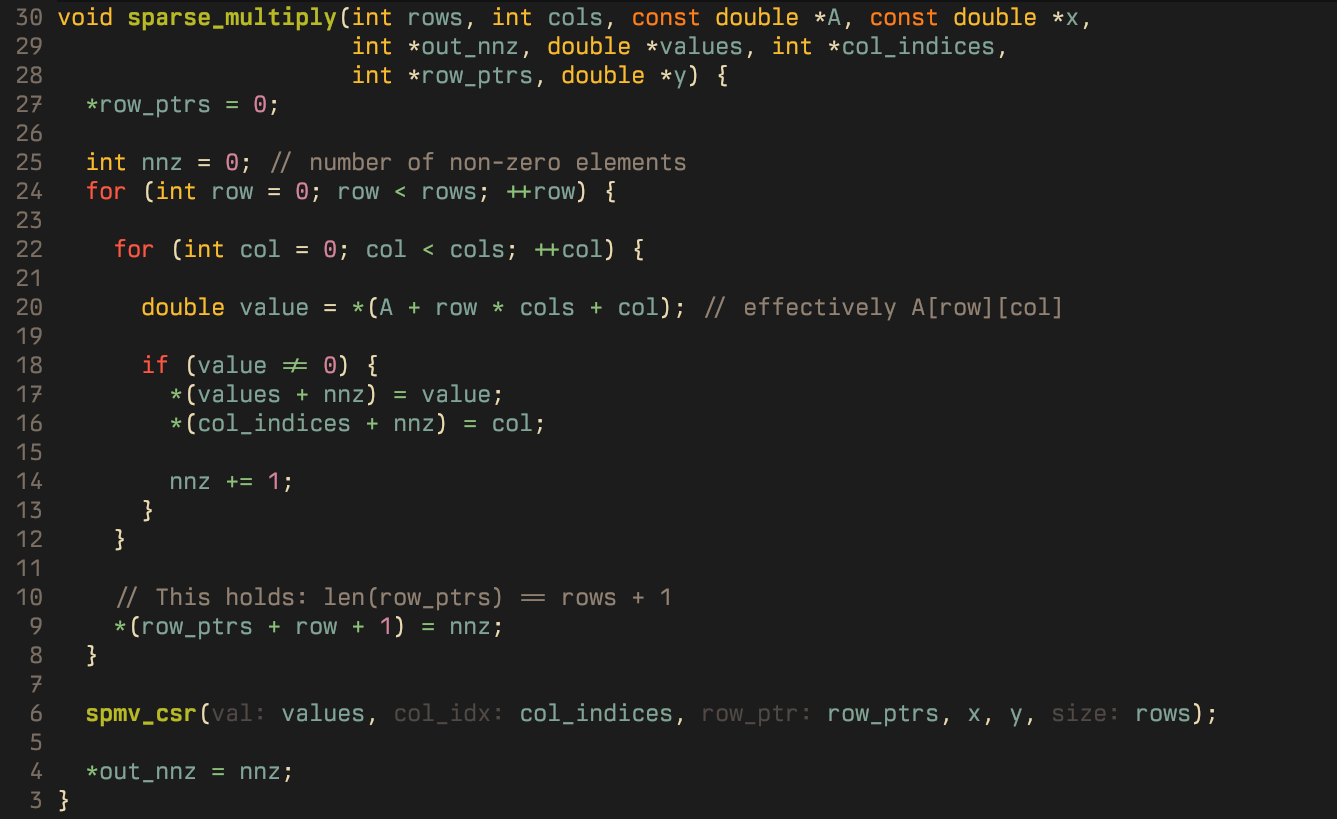
Sparse Matrix construction
- Scan matrix A in row-major order.
- If encounter non-zero element:
- Append it to values array.
- Append the current column col to col_indices array.
- Increment nnz (non-zero elements count)
Constructing the row_ptrs array felt tricky at first. The mismatch between row_ptrs and a single row's length felt off-putting, but then I reasoned that I can initialize the row_ptrs with 0 because every instance would always start with 0, only the later boundaries are not known. With one less runtime assignment, the rest of row_ptrs could be filled within the outer loop.
Therefore:
- The next boundary is always the current number of non-zero elements (nnz) , which I add to row_ptrs array after a row is processed.
- This completes the sparse matrix construction, after which, pass the required arguments to spmv_csr() function to perform sparse multiplication
- As final step, update the out_nnz variable.
Problems I faced
Information loss (wrong type): I declared sum in spmv_csr as int instead of double which resulted in test FAILS because the results weren't converging to the tolerable threshold due to loss of information bits.
Off-by-one error: As mentioned above, I got logic for row_ptrs wrong by shifting boundaries by one, to the left, so 0th value was being replaced.
Incorrect Pointer arithmetic I wrote following code to located current non-zero value in the matrix:
double value = *(A + row * cols * sizeof(double) + col * sizeof(double));
which is incorrect because in C/C++, the indexing is already scaled by size of data-type being pointed to, whereas I was thinking in terms of per-byte traversal.
Space-time complexity
Time: O(nnz) for sparse matrix multiplication
Space: O(nnz) for storing in CSR format
This implies that sparser the matrix, the better. Conversion of dense matrix to CSR is O(rows * cols) though!
I observed one more thing: The critical constraint mentioned kind-of made the problem easy for me to reason through because I didn't have to worry about dynamic memory management up front.
Results
Sparse Multiply
CSR Construction
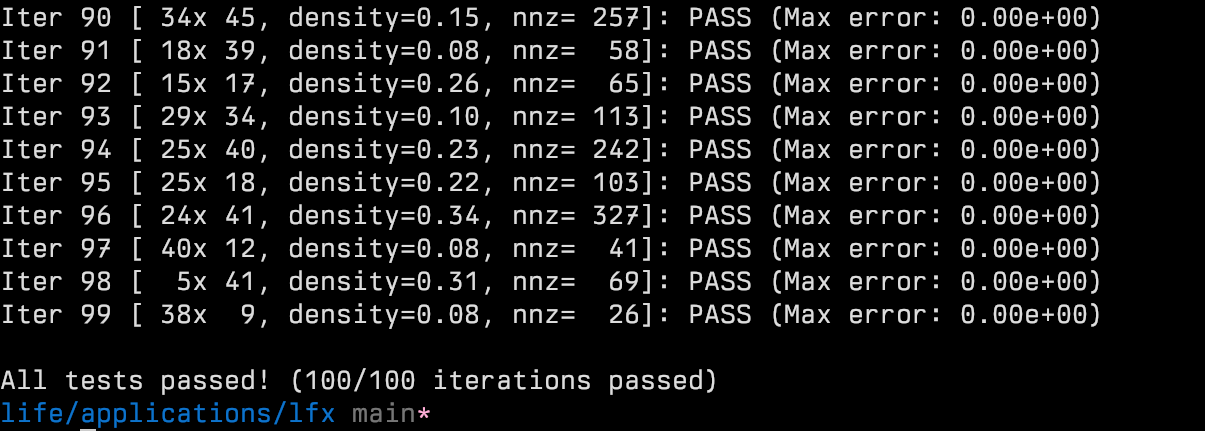
Test results:
Thank you!